Uptime Monitoring: SSL First, Not Dashboards, for Small Businesses
By Nick Phillips, Founder
Uptime Monitoring: SSL First, Not Dashboards, for Small Businesses

Uptime monitoring means scheduled checks that alert you when your site or an endpoint becomes unreachable. Add a simple monitor for your customer-critical pages today, plus an SSL expiry check. Downtime costs small businesses an average of $20,172 per year, and Google can slow its crawling of sites it cannot reach.
TL;DR:
- Check checkout and login every one to five minutes, and monitor less important pages less often to limit cost and alert noise.
- Add expiry alerts for every domain and subdomain, including forgotten hostnames, because a lapsed certificate can trigger browser security warnings while the server remains online.
- Require a second region to confirm an outage; a single location can report green while customers elsewhere cannot reach the site.
- Repeated server errors, DNS failures, or timeouts can slow Google crawling; check Search Console after incidents because unreachable URLs may leave the index within days.
- Start with a free tier for a handful of domains; pay only when you need more domains, faster checks, uptime guarantees, or shared team alerts.
Table of Contents
- What uptime monitoring is and why it matters for small businesses
- How downtime affects SEO, indexing, and crawling
- Key features small teams should look for in monitoring
- A simple setup checklist for small businesses
- Interpreting alerts and troubleshooting common causes
- What to expect on cost, and where to start
- Why we built around certificates first
- Why quiet monitoring beats busy dashboards
- A calm, certificate-first way to cover this checklist
- FAQ
- Sources
What uptime monitoring is and why it matters for small businesses
Think of a monitor as a tireless visitor. Every few minutes it knocks on your front door, checks that someone answers, and tells you when nobody does. You don’t have to be watching a dashboard. You just have to read the email.
Most small teams only ever need a handful of monitor types:
- HTTP(S) status checks: request a page and confirm it returns a healthy response, not an error.
- Ping or TCP checks: confirm a server or port is reachable at all, which helps when a page check fails and you need to know why.
- API and cron job checks: confirm that an endpoint responds, or that a scheduled job reported in on time.
- SSL certificate expiry checks: watch the date your certificate expires and warn you well before browsers start showing scary warnings.
The money side is real. A 2025 industry analysis found downtime costs small and midsize businesses an average of $20,172 per year, and that many of those surveyed reported direct revenue loss from poor site performance. The same reporting notes that many entry-level hosting plans lack or under-support CDN and caching features that help prevent outages. Bigger companies face larger numbers: the Internet Resilience Report 2025 highlights rising financial risk from outages, and flags third-party dependencies and monitoring gaps as multipliers of that risk.
Revenue is only half of it. A customer who hits an error page at checkout doesn’t file a ticket. They go back to search results and pick someone else. A browser warning about an expired certificate does the same damage, and it looks worse because it feels like a security problem.
Outages usually come from ordinary places:
- A hosting failure or an overloaded shared server.
- DNS problems, such as a record that was changed or a domain that lapsed.
- Firewall rules that accidentally block real visitors or your own monitoring.
- CDN or caching misconfiguration that serves stale or broken pages.
- An expired SSL certificate nobody remembered to renew.
None of these need deep ops skills to catch. They need something watching, and someone who gets told.
How downtime affects SEO, indexing, and crawling
Customers aren’t the only visitors who notice when your site is down. Google’s crawler does too, and it reacts. Google’s crawling documentation explains that network timeouts, connection resets, DNS errors, and HTTP 5xx responses can cause crawling to slow down, and that URLs left unreachable can be removed from the index within days.
That second part is the one that trips people up. A short blip rarely hurts. A site that keeps failing while Google comes knocking is a different story.
Google also thinks in terms of crawl budget, which comes from two things: how much crawling your server can handle (the crawl capacity limit) and how much Google wants to crawl your pages (crawl demand). Per Google’s crawl budget guidance, capacity rises when a site responds consistently and falls when response times grow or server errors appear. Slow or flaky servers get crawled less often, which means new pages and updates take longer to show up in search.
Google’s guidance in brief: Slower response times and server errors reduce crawl capacity and can decrease how often your site is crawled.
You can see this from your side without any special tooling. In Search Console, open the Crawl Stats report and look at host status. It breaks availability into four buckets:
- robots.txt fetching: whether Google could read your robots file at all.
- Server connectivity: whether Google could connect to your server.
- DNS resolution: whether your domain name resolved when Google asked.
- Server errors: whether your pages returned 5xx responses.
If any of those show problems, treat it like a customer-facing outage, because for search visibility it is one. For a small business, that usually means reading the report once a month and after any incident.
A speed note while we’re here: availability and performance are cousins. If you want to connect uptime work to business results, this explainer on why site speed matters for small business websites is a useful companion read.
Key features small teams should look for in monitoring
You don’t need a feature matrix with forty rows. You need a short list of things that decide whether monitoring helps you or just adds another inbox to ignore.
- Check frequency: for customer-critical pages, frequent checks are a sensible target. Faster checks catch outages sooner, but usually cost more, so save the tight intervals for pages that make you money, like checkout or login.
- Multi-location verification: a monitor that checks from only one region can show green while customers elsewhere see failures. Checks run from selected vantage points, so a green result doesn’t prove every visitor is fine. Look for tools that confirm a failure from a second location before alerting you.
- SSL certificate expiry monitoring: this is the highest-value, lowest-effort check on the list. Certificates expire on a known date, the failure is entirely preventable, and the warning costs nothing to send.
- Noise control: deduplicated alerts, simple email-first notifications, and no sprawling escalation trees. A small team doesn’t need a pager rotation. It needs one clear message that says what broke.
- Alert delivery options: email first, then a webhook or simple SMS for the things that truly can’t wait. Chat integrations like Slack start to matter once more than one person needs to see an alert.
- Sensible free tier: many services let you monitor a handful of domains at a basic frequency for free. Paid plans typically add shorter intervals, more domains, and more integrations.
If you want to see how one calm setup handles these together, our walkthrough on downtime alerts with two regions and SSL checks goes through it in detail.
Pro Tip: Before you pay for anything, list your five most important URLs and the one date each certificate expires. If a free tier covers those, you already have most of the value.
A simple setup checklist for small businesses
You can get meaningful monitoring running in an afternoon. Work through these in order:
- Inventory what customers actually touch. Write down your homepage, checkout or booking page, login, contact form, and any API endpoint an app or partner relies on. If it earns money or builds trust, it goes on the list.
- Add an SSL expiry check for every domain and subdomain. Don’t forget the odd ones: the
wwwversion, the shop subdomain, the old marketing site you still serve. Certificates on forgotten hostnames are the classic surprise outage. - Choose check intervals and two alert channels. Use short intervals for critical pages and longer ones for non-essential pages. Pick two channels, such as email plus a chat webhook, so one missed notification doesn’t mean a missed outage.
- Test the alert path. Point a test monitor at a URL that will fail, or pause a staging site, and confirm the alert arrives where you expect and reaches the right person. An untested alert is a hope, not a plan.
- Write a short runbook. One page is enough: who to contact at your host, who your developer is, where DNS is managed, and the first three things to check. Put phone numbers in it. You won’t want to hunt for them during an outage.
Teams that want extra detail on the first pass can use our guide to simple uptime monitoring, which pairs well with this list.
Once monitors are live, review them regularly. Sites change. A new subdomain appears, a certificate gets reissued, a checkout moves to a new path. A little upkeep keeps the list honest.
Interpreting alerts and troubleshooting common causes
An alert is a question, not a verdict. Your first job is to find out whether the outage is real, and then which layer is failing.
- Confirm it’s real. Repeat the check, ideally from a second region, and load the page yourself in a private browser window. If one probe fails and another passes, you may be looking at a regional routing issue or a false positive, not a full outage.
- Replay the transaction. If a simple page check passes but customers complain, walk through the actual flow: add to cart, log in, submit the form. Synthetic transaction checks catch failures that a homepage ping misses.
- Check dependencies. Look at DNS first, then your CDN, then any third-party API your pages call, like payments or booking. Their status pages often explain the problem in seconds. Dependency-specific symptoms deserve their own investigation.
- Work the remediation checklist. Check server health (CPU, memory, disk space), look at recent deploys or plugin updates, and review error logs. If a change went out just before the alert, roll it back first and debug later.
- Contact your host. If the server is unreachable or unhealthy and you can’t see why, open a ticket with your host straight away rather than guessing.
When you escalate to a developer or host, send details instead of “the site is down.” Include the exact URL, the time the alert fired, which regions saw the failure, the error or status code returned, and what changed recently. That turns a vague request into something they can act on in minutes.
If you suspect a certificate problem specifically, our post on HTTPS uptime monitoring and certificate outages shows how those failures happen and how to spot them early.
What to expect on cost, and where to start
Good news: the entry point is cheap. Many monitoring services offer free tiers that cover a handful of domains with basic check frequency. For a small business with one main site and a few supporting domains, that is often enough to start.
Paid plans typically earn their price when one or more of these things change:
- You manage more domains. Agencies and owners with several brands outgrow free limits quickly.
- You need faster checks. Sub-minute intervals matter when seconds of downtime cost real sales.
- You need guarantees. If customers or contracts expect uptime commitments, you’ll want better reporting.
- More people need alerts. Team integrations, shared notifications, and client-facing reports usually sit on paid tiers.
A practical entry-level combination looks like this:
- Basic uptime checks on your customer-critical URLs.
- SSL expiry monitoring on every domain.
- A webhook or email forwarding rule that drops alerts into a simple chat channel.
- A status page, if customers regularly ask whether you’re down.
Hosting is part of the cost picture too. If outages keep tracing back to your plan, an upgrade may save more than any monitor will. This partner piece on what small organizations should actually pay for hosting and management is a helpful read before you decide.
Start free, measure how often alerts fire, and upgrade only when a real limit gets in your way.
Why we built around certificates first
We’ve watched small teams do everything right and still get caught by an expired certificate on a subdomain nobody remembered. The site was fine. The server was fine. A date quietly passed, and visitors saw a full-screen browser warning. That’s why we put certificates first and uptime second: expiry is the one outage you can see coming weeks ahead.

Our approach fits small teams for a simple reason. They don’t have someone to read dashboards, so the tool has to be quiet until something matters, then say it plainly. One friendly email beats a wall of red graphs.
If you want step-by-step configuration beyond this article, we’ve written up our thinking on small-team uptime monitoring that puts SSL first and on multi-region checks. Both are written for people who would rather run a business than run an ops team.
Why quiet monitoring beats busy dashboards
The conventional advice says more monitoring is better: more checks, more graphs, more alert rules, more integrations. For a small team, I think that’s backwards. Every extra alert you can’t act on teaches you to ignore the next one, and the ignored one is usually the one that matters.
What the evidence in this article supports is narrower. Outages cost real money, crawlers react to unreachable servers, and a green check from one region proves little. None of that argues for an enterprise dashboard. It argues for a short list of important URLs, a certificate date you never forget, a second region to confirm failures, and an alert that reaches a human who knows what to do.
So start small. Cover the page that makes you money, then every certificate, then write the one-page runbook. Add sophistication only when a real incident shows you a gap. Vendor comparison tables can wait.
— Nick Phillips
A calm, certificate-first way to cover this checklist
We built Otterwatch for exactly the list above. It watches your SSL certificates and warns you well before they expire, while quietly checking that your sites are up. Alerts arrive as plain, friendly emails from Otis, our park ranger otter, with no alarm language and no dashboard to babysit. It offers a free plan for multiple domains, with no credit card needed, so setup is as simple as pasting in your domains.
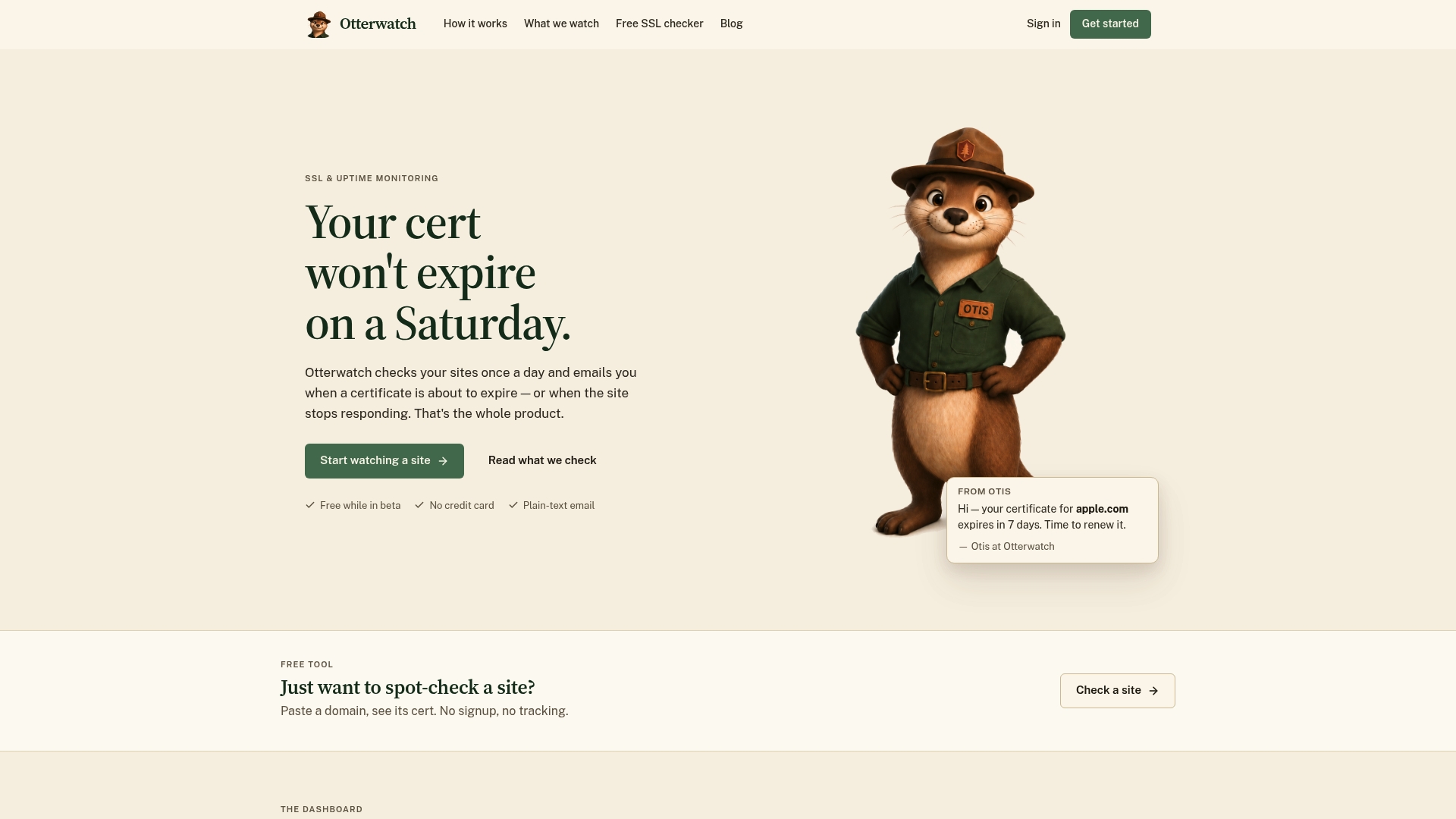
That covers SSL expiry alerts, simple setup, and quiet notifications in one place. When you outgrow the free plan, our Pro tier is $15 per month and adds deeper certificate monitoring and more integrations. Want a hands-on look first? Run any domain through our free SSL Certificate Checker, or head to Otterwatch and add your first site today.
FAQ
What is small business uptime monitoring?
It is a service that checks your website or endpoints on a schedule and alerts you when they stop responding. Small teams usually start with checks on their most important pages plus an SSL expiry check.
How often should a small business check uptime?
For customer-critical pages like checkout or login, checks every one to five minutes are a sensible target. Less important pages can be checked less often, which also keeps costs and alert noise down.
Can downtime hurt my Google rankings?
Repeated failures can. Google’s documentation says timeouts, DNS errors, and 5xx responses can slow crawling, and URLs that stay unreachable can be dropped from the index. A brief blip is far less risky than a recurring problem.
Is free uptime monitoring good enough for a small business?
Often, yes, to begin with. Free tiers commonly cover a handful of domains at basic frequency, which suits a single site and a few supporting domains. Upgrade when you need more domains, faster checks, or team integrations.
Why do I need SSL expiry alerts if my site is up?
An expired certificate makes browsers show a security warning, so visitors leave even though your server is healthy. Expiry is also fully predictable, which makes an early warning one of the cheapest checks you can add.
Sources
Recommended
- Stop Chasing False Alerts: Small Team Uptime Monitoring That Puts SSL First
- Downtime Alerts: Two Regions, SSL Checks, Less Noise for Small Teams
- SSL certificate monitoring tools, honestly compared
- Low Noise Certificate First API Uptime Monitoring for Small Teams
Catch the next cert expiry before your users do.
Otterwatch checks your SSL certificates daily and emails you 30 days before they expire. Five sites free.
Start watching →