Reduce Alert Fatigue Fast: 90 Day Playbook for Ops and Clinical Teams
By Nick Phillips, Founder
Reduce Alert Fatigue Fast: 90 Day Playbook for Ops and Clinical Teams
Audit your alerts, delete or demote anything that never drove action, assign an owner and runbook to what remains, convert cause based rules to symptom or SLO based ones, then turn on deduplication and suppression. Track two numbers as you go: pages per on-call shift and signal to noise ratio. A phased 90-day plan makes this manageable instead of overwhelming.
TL;DR:
- Eliminating alerts that never prompted action can significantly reduce noise, especially those with consistently high ignore rates and no owner or runbook.
- Tracking metrics like signal to noise ratio and pages per shift helps identify the most impactful areas for alert tuning and elimination.
- Converting cause-based alerts to symptom- or SLO-based ones, with appropriate duration and burn-rate controls, cuts unnecessary pages without risking missed issues.
- Implementing deduplication, alert correlation, and suppression transforms multiple identical alerts into single incidents, easing operator workload.
- Establishing clear ownership, documented runbooks, and periodic review cycles is essential to sustain alert quality and prevent orphaned rules.
Table of Contents
- Quick Wins to Reduce Alert Fatigue in 24 to 72 Hours
- How Do You Measure Your Alert Fatigue Baseline?
- Tactical Alert Tuning: Thresholds, Duration, and SLOs
- Collapsing Alert Storms Into a Single Incident
- Who Owns Each Alert, and What Happens When It Fires?
- A 90-Day Plan to Reduce Alert Fatigue for Good
- A Focused Example: Calm Certificate Expiry Alerts
- Why Fixing Alert Fatigue Is Harder Than It Sounds
- A Calmer Way to Handle One Predictable Alert Source
- Sources
- FAQ
Quick Wins to Reduce Alert Fatigue in 24 to 72 Hours
You don’t need a quarter-long project to feel relief. Most teams can cut a meaningful chunk of noise in a weekend by working through a short checklist.
- Run a fast noise audit. Pull every alert that fired in the last 30 days and rank them by volume multiplied by ignore rate. The worst offenders usually jump out immediately.
- Delete or demote dead weight. If an alert has never once led to a real action, kill it or move it to a dashboard. Informational noise does not belong on a pager.
- Assign an owner to every page-level alert. No owner, no runbook, no page. That single rule eliminates a surprising share of orphaned alerts.
- Add hold time and recovery thresholds. A metric that flickers above and below a line for ninety seconds should not wake anyone.
- Turn on basic deduplication and maintenance suppressions. Repeated identical firings should collapse into one open item, not twenty.
Pro Tip: Before you touch a single threshold, screenshot your current pager volume for a week. You’ll want that baseline in three months when someone asks whether any of this actually worked.
How Do You Measure Your Alert Fatigue Baseline?
You can’t fix what you haven’t counted. Start by inventorying every alert rule across your stack and pulling three numbers for each: how many times it paged over a 30 to 90 day window, what fraction were auto-resolved or ignored, and whether it has a named owner and a linked runbook.
From that inventory, calculate four figures that matter more than any dashboard vanity metric:
- Signal to noise ratio (SNR): the percentage of pages that led to real action. Anything under 30% actionable is a flashing sign that the rule needs tuning or deletion.
- Pages per on-call shift: a rough industry target is fewer than two pages per twelve-hour shift. Above that, fatigue sets in fast.
- Mean time to acknowledge (MTTA): rising MTTA over time is often the earliest tell that a team has started tuning out its own pager.
- Off-hours page rate: how many alerts fire between, say, 10 p.m. and 7 a.m., and whether they truly need a human awake for them.
One operational framework built around noise audits found that 70 to 85% of alerts in a typical environment are duplicate, auto-resolved, or purely informational and can be pulled off the pager entirely without losing coverage. That is the kind of number worth chasing down in your own environment before you touch a single threshold.
Once you have the data, build a simple matrix: volume on one axis, ignore rate on the other. The alerts sitting in the high volume, high ignore rate corner are your highest leverage fixes. Start there, not with whatever rule is most annoying you personally this week.
Tactical Alert Tuning: Thresholds, Duration, and SLOs
Filtering notifications is a Band-Aid. Changing what generates a page in the first place is the actual fix, and it starts with the difference between cause based and symptom based alerts.
A cause based alert fires the moment a condition exists, like CPU crossing 90%. A symptom based alert fires only when that condition actually affects something a user or patient would notice, like request latency breaching a threshold users feel. Symptom based alerting typically cuts page volume sharply without leaving real problems undetected, because most cause level fluctuations resolve themselves before they ever become symptoms.
Duration and hold times fix the second biggest source of noise: flapping. A rule of thumb that works for most environments is requiring a condition to persist for two to five evaluation cycles before paging, and requiring a similar hold before declaring recovery. Datadog’s operational guidance on evaluation windows and recovery thresholds is a good reference point if you’re building this from scratch.
Dynamic baselining takes this further by comparing current behavior against a rolling historical pattern instead of a fixed number, which matters enormously for anything with daily or seasonal cycles. Pair that with multi-window burn-rate alerts, which check both a fast short window and a slower long window against the same threshold, and you catch sudden spikes without also catching slow, survivable degradation as an emergency.
SLO-based alerting ties the whole thing together. Instead of asking “is this metric abnormal,” you ask “how fast are we burning through our error budget.” A fast burn against a tight budget justifies an immediate page; a slow burn against a generous budget can wait for the next business day ticket.
Pro Tip: Map every existing page-level alert to an SLO before you delete anything. If you can’t name which user-facing promise an alert protects, that’s your answer on whether to keep it.
- Symptom based alerts protect what users experience, not internal machine state.
- Hold times of two to five cycles eliminate most flapping without delaying real detection.
- Burn-rate windows let short spikes and slow leaks trigger different urgency levels.
Collapsing Alert Storms Into a Single Incident
A single root cause can spray twenty identical looking alerts across five tools in under a minute. Deduplication, correlation, and suppression are the three mechanisms that turn that storm into one incident with one owner.
Deduplication collapses repeated identical firings of the same rule into a single open alert instead of a new ticket every time it re-fires. This is the easiest win on the list, and most modern alerting platforms support it natively.
Correlation groups alerts that share a root cause across different services or tools, even when the underlying rules and wording look nothing alike. Grouping keys built around shared infrastructure, like a host, a region, or a database cluster, work well here, and topology-aware correlation goes further by understanding which services depend on which.
Suppression and inhibition rules quiet known-benign patterns and scheduled maintenance windows, and they inhibit downstream alerts once the upstream root cause alert is already open. If a database is down and you already have a page for it, you don’t need forty more pages for every service that depends on it.
- Enable deduplication first. It requires the least configuration and produces immediate relief.
- Build correlation around real topology, not just naming conventions, or you’ll miss cross-tool storms.
- Reserve suppression for known, documented patterns. Guessing at what’s “probably fine” is how real incidents get missed.
- Let automation handle the first three items above; keep a human in the loop before any auto-triage that can close or downgrade an alert without review.
Configuration guides for grouping and suppression show these mechanics in practice, including the alertmanager-style patterns most teams end up implementing regardless of which tool they run.
Who Owns Each Alert, and What Happens When It Fires?
Tools only get you halfway. The other half is governance, and governance starts with a rule that sounds almost too simple: no alert exists without a named owner, a review date, and a documented reason it still pages.
- Assign ownership explicitly. Every alert rule should list a person or team responsible for it, plus a date it was last reviewed. Orphaned rules from a former team member’s era are a common, quietly enormous source of noise.
- Write a minimum viable runbook. At minimum it needs a plain-language explanation of what the alert actually means, the top three diagnostic steps, the remediation actions, and clear criteria for when to escalate rather than handle it alone.
- Use a three-layer notification model. Page-level goes to a human immediately for anything with real urgency. Ticket-level creates a tracked item for anything that needs attention but not a 3 a.m. wake-up. Log-level simply records the event for later analysis.
- Design rotations around realistic workload. If your baseline shows more than two pages per shift, that’s a signal to fix the alerts, not just to add more people to the rotation.
Pro Tip: When you write a runbook, have someone unfamiliar with the system read it cold. If they can’t diagnose the issue from your three steps, the runbook is too vague to be useful during an actual incident.
Clinical environments face a version of this same problem: interruptive alerts that get tailored to actual patient risk factors, rather than firing uniformly for everyone, both reduce clinician cognitive load and improve safety indicators. The underlying principle transfers cleanly to any operations environment: specificity and ownership beat blanket coverage.
A 90-Day Plan to Reduce Alert Fatigue for Good
Trying to fix everything in one sprint tends to break things that were working fine. A phased rollout protects you from that.
- Days 1 to 30: Run the full noise audit, rank alerts by the volume times ignore-rate matrix, and apply temporary suppressions to the most obvious offenders while you plan permanent fixes.
- Days 31 to 60: Delete or demote unactionable alerts, add duration and recovery thresholds across the board, assign owners, and write runbooks for everything that remains on the pager.
- Days 61 to 90: Turn on correlation and grouping, automate suppression for well-documented benign patterns, and pilot limited auto-triage under a clear human-review policy.
| Milestone | What to check | Target signal |
|---|---|---|
| Day 30 | Noise audit complete, top offenders ranked | Baseline SNR and pages-per-shift recorded |
| Day 60 | Owners and runbooks assigned | Rising SNR, fewer duplicate pages |
| Day 90 | Correlation and automation live | Pages per engineer trending down, MTTA stable or improving |
A Focused Example: Calm Certificate Expiry Alerts
Certificate expiry is one of the most predictable, and most badly handled, sources of preventable noise. An effective approach sends plain-language warnings at scheduled intervals well ahead of expiry, so there’s never a last-minute scramble.
- Expiry alerts route as ticket-level notices at 30 and 14 days out, escalating to page-level only inside the final 72-hour window.
- Reachability checks run alongside certificate monitoring, catching downtime without adding a second noisy tool to babysit.
- Teams building this pattern from scratch can start with a guide on scheduling certificate-expiry email alerts or a breakdown of expiry alert types and how to map them to ticket versus page severity.
Why Fixing Alert Fatigue Is Harder Than It Sounds
The resistance to cutting alert volume rarely comes from laziness. It comes from a safety-first instinct that says more alerts equal more protection, even when the evidence points the other way. Clinical literature has already shown that modifying and reducing low-value alerts does not increase safety incidents, it reduces the noise that buries the alerts that actually matter.
The common failure mode isn’t over-deleting. It’s under-measuring. Teams turn off alerts, feel a quick sense of relief, and never check whether pages-per-shift or SNR actually moved. Treat every change as a measured experiment with a before and after number, not a one-time cleanup.
— Nick Phillips
A Calmer Way to Handle One Predictable Alert Source
Certificate expiry is one of the few alert categories you can make almost entirely predictable, and Otterwatch is built around exactly that. It watches your certificates and warns you well before they expire, in plain language, without the wall of red alarms most monitoring tools default to. Reachability checks run alongside it, so uptime gets covered too, quietly, as a bonus rather than the main event.
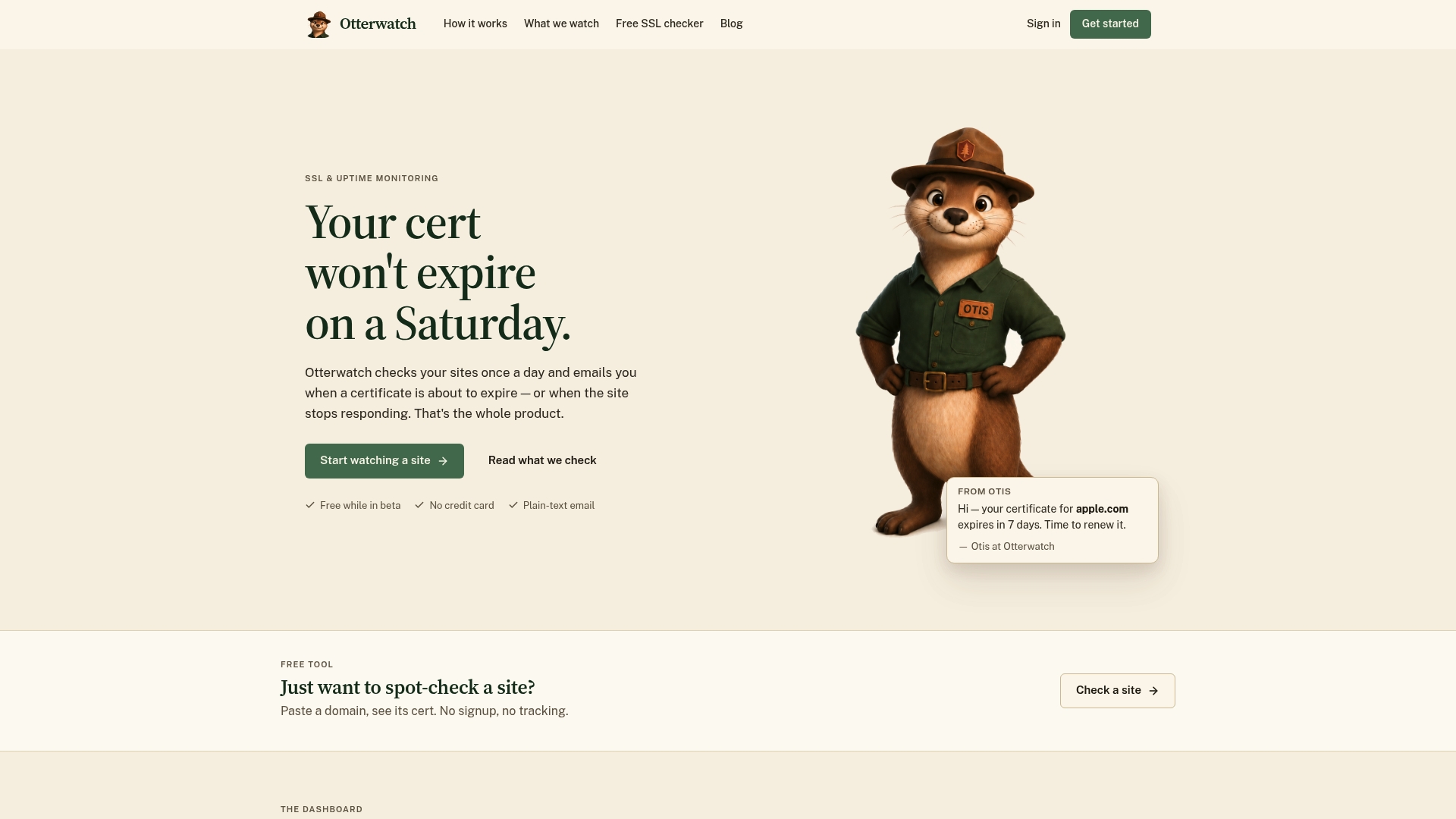
If your alert audit turned up certificate expiry as one of your noisiest, most avoidable categories, that’s a good place to start applying everything above. Some services offer free monitoring for a limited number of sites with core expiry and uptime alerts included, no card required. Run your first check with the free SSL certificate checker and see how a certificate-first alert actually feels when it stops being a fire drill.
Sources
- Creating Meaningful Alerts and Reducing Alert Fatigue - PMC
- Alert fatigue - PSNet (AHRQ)
- Alert Fatigue: Causes, Real Costs, and How to Fix It (Nova AI Ops)
FAQ
What Helps Reduce Alarm Fatigue?
Tailoring alerts to actual risk, removing non-actionable alerts, and requiring a documented owner and runbook for anything left on the pager are the interventions with the strongest evidence behind them, according to AHRQ’s patient-safety primer.
What Does Alert Fatigue Mean?
Alert fatigue is the desensitization that happens when people receive so many low-value alerts that they start ignoring, delaying, or missing the ones that genuinely matter.
What Is Notification Fatigue?
Notification fatigue is the broader version of alert fatigue that applies to any high-volume alerting system, not just clinical settings, and it shows the same pattern: excessive volume erodes response speed and accuracy over time.
What Is the Key Strategy for Avoiding Alarm Fatigue?
Increasing alert specificity, so each alert reflects genuine urgency rather than a generic threshold, is the strategy most consistently backed by clinical evidence, paired operationally with symptom or SLO-based alerting and consistent deduplication.
Can a Tool Like Otterwatch Help Reduce Alert Fatigue?
Yes, for one specific and common source of noise: certificate expiry. Otterwatch sends scheduled, plain-language warnings ahead of expiration instead of a last-minute page, which fits naturally into the ticket-versus-page structure described in this guide.
Recommended
Catch the next cert expiry before your users do.
Otterwatch checks your SSL certificates daily and emails you 30 days before they expire. Five sites free.
Start watching →