Why Short-Lived Certificates Need Monitoring in 2026
By Nick Phillips, Founder

Short-lived TLS certificates are defined as SSL/TLS certificates with validity periods of 90 days or fewer, and monitoring them is not optional. As certificate authorities like Let’s Encrypt push toward 45-day lifetimes and the CA/Browser Forum moves to compress lifetimes further, the operational stakes for website owners and IT managers have never been higher. The core problem is simple: shorter lifetimes mean more frequent renewals, and more frequent renewals mean more opportunities for something to go wrong silently. Understanding why short-lived certificates need monitoring starts with recognizing that automation alone is not a safety net. It is a pipeline that can fail at any step.
Why short-lived certificates need monitoring differently than traditional certs
Short-lived certificates change the math on certificate management in ways that catch teams off guard. With a traditional one-year certificate, a missed renewal alert gives you weeks to respond. With a 45-day certificate lifetime, renewal occurs roughly every 30 days, which compresses your error tolerance window from weeks down to hours or days. That is not a minor operational adjustment. It is a fundamentally different risk profile.

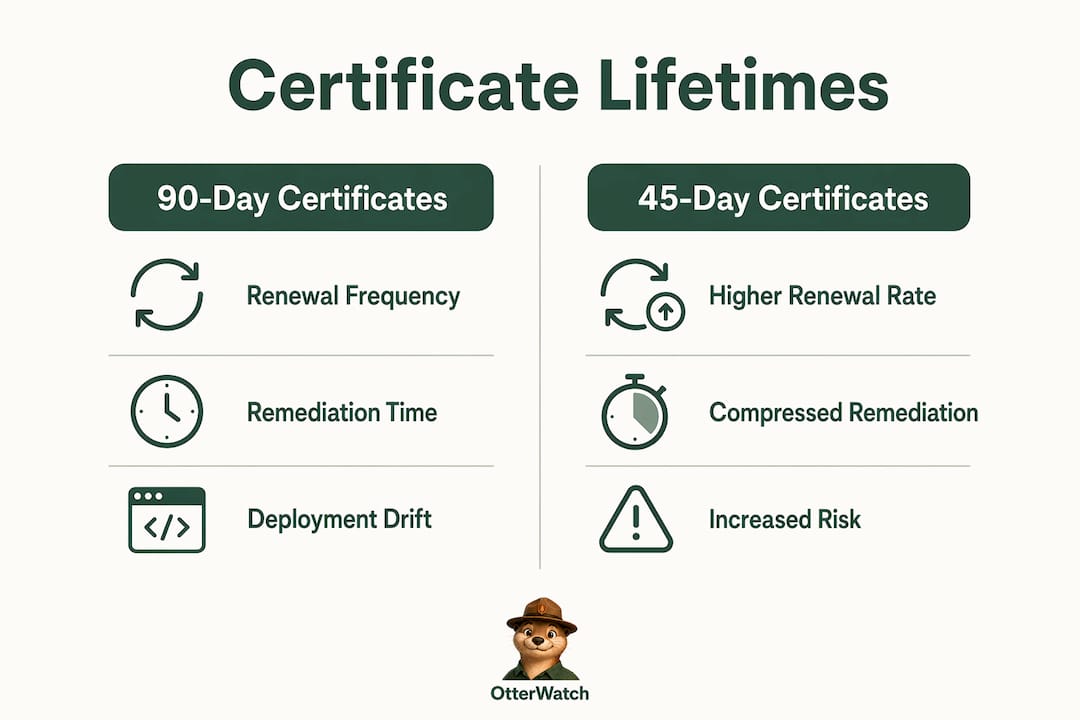
Here is a direct comparison of how the two models differ in practice:
| Factor | 90-day certificates | 45-day certificates |
|---|---|---|
| Renewal frequency | Every 60-75 days | Every 30 days |
| Remediation window | Days to weeks | Hours to days |
| Manual management viability | Difficult but possible | Not viable |
| Alert threshold needed | 30 days before expiry | 2-5 days before expiry |
| Failure impact speed | Gradual | Near-immediate |
The shift to shorter lifetimes also introduces a new category of risk: deployment drift. Your ACME client (tools like Certbot or acme.sh handle this automatically) might renew the certificate successfully, but if the proxy or load balancer never reloads, the old certificate keeps serving. From the outside, your site looks fine until it suddenly does not. Continuous automated observability becomes mandatory because manual management simply cannot keep pace with renewal cycles measured in weeks.
The other shift worth noting is the compression of remediation time. With a 90-day cert, a failed renewal job discovered on day 60 still leaves you 30 days to fix it. With a 45-day cert renewed every 30 days, a failure discovered at the same relative point leaves you 15 days. Miss one more check-in cycle and you are looking at an outage, not a warning.
What monitoring practices actually prevent outages with short-lived certs
Monitoring short-lived certificates requires watching more than just the expiration date. The importance of certificate monitoring has expanded to cover the entire renewal lifecycle, and each stage is a potential failure point.
Here is the monitoring stack you need to have in place:
-
Renewal job health checks (dead man switch). Your cron job or ACME client should check in with a monitoring system on every successful run. If it goes silent, that silence is the alert. Tools like Healthchecks.io or a custom webhook endpoint work well here. A missed check-in means the renewal pipeline has stalled before you see an expired cert.
-
End-to-end external TLS validation. After renewal, verify that the certificate actually being served to users is the new one. This means performing a real TLS handshake from outside your network, checking the leaf certificate, the full chain, and the hostname match. Renewal success alone does not prevent outages if the cert is not deployed correctly.
-
Multi-location verification. A certificate might deploy correctly on your origin server but fail to propagate to CDN edge nodes or regional load balancers. Run external checks from at least three geographic locations to catch regional inconsistencies before your users do.
-
Trust chain and issuer validation. Proper monitoring covers trust chain verification, hostname accuracy, cipher compatibility, and unexpected issuer changes. An intermediate certificate mismatch will break browsers even if the leaf cert is valid and current.
-
Tightened alert thresholds. A 30-day expiry warning makes no sense for a 45-day certificate. Set your first alert at 5 days, a second at 2 days, and a final at 1 day. These thresholds give you time to act without drowning you in noise during normal operations.
Pro Tip: Set your monitoring alerts to fire on two independent signals: the certificate’s remaining validity AND the last successful renewal job check-in. If either goes quiet, you want to know immediately. One signal alone leaves blind spots.
What risks come from inadequate monitoring of short-lived certificates
The risks of unmonitored certificates are not theoretical. They show up as real outages with real business costs.
- Silent renewal failures. DNS propagation delays, rate limits, firewall changes, or permission errors can all cause renewal jobs to fail without generating any visible error. The certificate keeps serving until it expires, and then users hit a wall.
- Deployment errors. Renewing a certificate but failing to reload Nginx, Apache, or a load balancer means the old cert keeps serving. A chain mismatch or partial rollout to a CDN produces the same result from the user’s perspective.
- Browser trust errors. Users see “Your connection is not private” in Chrome or Firefox, and most of them leave immediately. They do not file a support ticket. They just go.
- SEO damage. Google treats HTTPS as a ranking signal. A certificate outage that lasts hours can trigger crawl errors and ranking drops that take weeks to recover from.
- Reduced recovery time. Short-lived certificate lifetimes compress failure windows, meaning any missed renewal can cause immediate service failures with almost no buffer to catch and fix the problem.
“Expired certificates led to a six-hour checkout outage, illustrating the cost of not monitoring renewal job success and deployment.” This is not an edge case. It is a predictable failure mode that monitoring directly prevents.
The cybersecurity compliance implications are also real for smaller organizations. An expired certificate on a payment or login endpoint can trigger compliance violations under PCI DSS or SOC 2, adding regulatory exposure on top of the operational damage.
How automation and monitoring tools integrate for reliable certificate management
Automation handles renewal. Monitoring verifies that automation worked. These are two separate jobs, and conflating them is where most teams get into trouble.
The most reliable architecture treats renewal as a multi-step pipeline with monitoring at every stage: order or renew, domain validation, certificate install, service reload, and final verification. Each step should emit a signal. If any step goes silent or returns an error, the alert fires before the certificate expires.
ACME clients with ARI (ACME Renewal Information) support, such as Certbot with the latest extensions or Caddy’s built-in ACME handling, can time renewals more precisely based on CA-suggested windows. This reduces unnecessary renewal attempts and rate-limit collisions, which are a real problem when you manage dozens of certificates across multiple domains.
External canary checks that perform real TLS handshakes are the most reliable way to confirm what users actually see. These outside-in checks catch deployment drift, regional CDN inconsistencies, and edge node failures that internal system checks miss entirely. An internal check that queries your certificate store might show a valid cert while your CDN edge in Singapore is still serving the expired one.
Pro Tip: Run your external TLS handshake check from at least one location in each major region where your users are. A certificate that looks fine from US-East can still be broken on a CDN edge in Europe or Asia-Pacific.
Elastic Workflows is one example of an orchestration layer that can wire these steps together, but the principle applies regardless of your tooling. The goal is a closed-loop workflow: detect a problem, alert the right person, remediate, and then verify the fix was actually deployed. Skipping the final verification step is how teams end up thinking they fixed an outage when the broken cert is still serving on two of five edge nodes.
Actionable steps to improve your certificate monitoring today
You do not need to rebuild your entire infrastructure to get better coverage. Here is a practical sequence to work through:
-
Audit your full certificate inventory. Include partner-managed endpoints, legacy subdomains, and any third-party services that terminate TLS on your behalf. Shadow certificates on forgotten subdomains are a common source of surprise outages.
-
Add renewal job monitoring. If your Certbot or ACME client runs on a cron schedule, point it at a dead man switch service. A missed check-in triggers an alert before the cert expires.
-
Set up external TLS validation. Use a monitoring tool that performs real handshakes from outside your network. Verify the leaf cert, the chain, and the hostname on every check.
-
Reconfigure your alert thresholds. If you are running 45-day certificates, a 30-day warning is nearly useless. Set alerts at 5 days, 2 days, and 1 day remaining validity.
-
Add multi-location checks. At minimum, check from two geographic regions. If you use a CDN, check from a location that routes through your CDN edge nodes, not just your origin.
-
Test your renewal workflow in staging. Run a forced renewal on a non-production certificate, verify the reload, and confirm the new cert is served. Do this quarterly so you know the pipeline works before it matters.
Key takeaways
Monitoring short-lived certificates requires continuous, multi-stage validation of the entire renewal pipeline, not just an expiration date alert.
| Point | Details |
|---|---|
| Shorter lifetimes compress risk windows | With 45-day certs, a missed renewal leaves hours to recover, not weeks. |
| Renewal success does not equal deployment success | Always verify the new cert is actively served after every renewal. |
| Multi-location checks catch CDN drift | Regional edge nodes can serve expired certs even when your origin is fine. |
| Alert thresholds must match cert lifetime | Set warnings at 5 days, 2 days, and 1 day for short-lived certificates. |
| Treat renewal as a monitored pipeline | Each step (order, validate, install, reload, verify) needs its own health signal. |
What I’ve learned watching short-lived certs fail in the wild
I have seen the same failure pattern repeat more times than I can count. A team sets up Certbot, confirms it runs on a cron job, and considers the problem solved. Then six months later, a firewall rule changes, or a DNS record gets updated, and the ACME challenge silently fails. The cert renews fine for another cycle because the old one has not expired yet. Then it does expire, and nobody has a monitoring alert because the team assumed automation meant the problem was handled.
The uncomfortable truth about short-lived certificate management is that automation must be continuously supervised. The more automated your renewal pipeline, the more critical it is to monitor that automation’s health. Automation removes the human from the loop, which is exactly what you want until something breaks and there is no human watching.
The other thing teams consistently overlook is the difference between internal and external visibility. Checking your certificate store from inside the server tells you what is installed. It does not tell you what is being served to users. Those two things can diverge in ways that are genuinely hard to diagnose without outside-in monitoring. I built Otterwatch specifically because I wanted something that watches from the outside, the way a real user’s browser does, without requiring a full observability platform to set it up.
The mindset shift that actually helps is treating your certificate renewal pipeline the same way you treat your deployment pipeline. You would not ship code without a health check. Do not renew certificates without one either.
— Otis
Keep your short-lived certificates covered with Otterwatch

Otterwatch watches your SSL certificates from the outside, the way a browser does, and sends you a plain heads-up well before anything expires. It checks from multiple locations, validates the full cert chain, and monitors uptime at the same time. There are no dashboards to configure and no walls of red alerts. Otis just sends you a calm, clear message when something needs attention. If you manage short-lived certificates and want to stop worrying about silent renewal failures or deployment drift, start monitoring for free with five sites covered at no cost.
FAQ
What are short-lived TLS certificates?
Short-lived TLS certificates are SSL/TLS certificates with validity periods of 90 days or fewer, with 45-day certificates now being pushed by Let’s Encrypt and the CA/Browser Forum. Their shorter lifetimes improve security by reducing the exposure window for compromised keys.
Why do short-lived certificates need monitoring more than longer-lived ones?
With 45-day certificates, renewal occurs roughly every 30 days, which means a single failed renewal can cause an outage within days rather than weeks. The compressed timeline makes manual oversight impractical and silent failures far more dangerous.
What does certificate monitoring actually check?
Effective monitoring checks expiration date, trust chain validity, hostname match, cipher compatibility, renewal job health, and whether the correct certificate is actively being served to users from all edge locations.
Can automation replace monitoring for short-lived certificates?
Automation handles renewal, but it cannot verify itself. Renewal jobs can fail silently due to DNS issues, rate limits, or permission errors, and a successfully renewed certificate can still fail to deploy if a proxy or load balancer does not reload.
How should I set alert thresholds for 45-day certificates?
Set your first alert at 5 days remaining, a second at 2 days, and a final at 1 day. A 30-day warning threshold designed for annual certificates provides almost no useful lead time when your cert lifetime is 45 days.
Recommended
Catch the next cert expiry before your users do.
Otterwatch checks your SSL certificates daily and emails you 30 days before they expire. Five sites free.
Start watching →